Everything About Artificial Marble & Its Manufacturing Process
Jan 23, 2026
Are you planning a residential renovation or selecting materials for a commercial project? Choosing between artificial marble (also referred to as engineered stone or cultured marble) and natural marble is one of the most critical decisions affecting both your budget and long-term durability.
In this comprehensive guide, we will break down what artificial marble is, explore its step-by-step manufacturing process, compare its technical performance against natural stone, and help you determine which surface is right for your needs.
What is Artificial Marble?
Artificial marble (composite or cultured marble) is a synthetic building material engineered by blending recycled crushed marble dust and mineral fillers (typically 80%–90% of the total volume) with thermosetting resins (10%–15% unsaturated polyester or epoxy) and pigments.
To achieve specialized aesthetic effects or higher density, high-end manufacturers may also incorporate crushed quartz, seashells, or decorative glass chips. Once mixed, the compound is poured into precision molds, cured under pressure, and sealed with a protective gel coat finish to deliver a sleek, uniform appearance.
Note: Artificial marble should not be confused with porcelain/ceramic marble-look tiles or engineered quartz. Ceramic tiles are fired clay products, while quartz surface relies primarily on natural silicon quartz grains.
The Step-by-Step Artificial Marble Manufacturing Process
Understanding the artificial marble manufacturing process highlights why engineered stone offers superior consistency and lower initial costs compared to quarry-mined slabs:
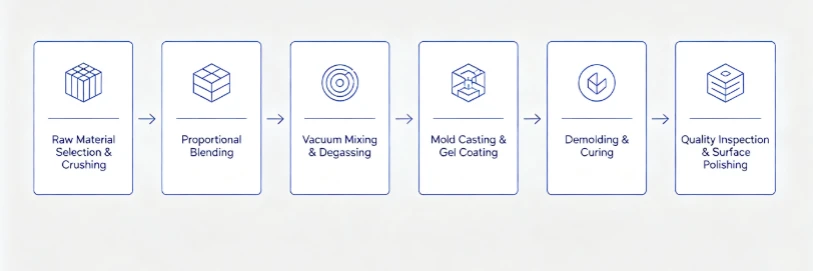
- Raw Material Selection & Crushing: High-grade natural marble scraps and dust are collected from quarry waste, sorted by color, and crushed into controlled granule sizes ranging from ultra-fine powder to coarse aggregates.
- Proportional Blending & Resin Addition: The crushed marble aggregate is mixed with unsaturated polyester resin, color pigments, curing catalysts, and structural accelerators.
- Vacuum Mixing & Degassing: To prevent internal air pockets, micro-bubbles, and structural porosity, the slurry undergoes high-speed mixing inside an industrial vacuum chamber.
- Mold Casting & Gel Coating: Before pouring, molds are sprayed with a durable, high-gloss isophthalic gel coat. The marble resin mixture is then poured into the molds and compacted using high-frequency industrial vibration tables to maximize density.
- Curing & Demolding: The casted material cures under controlled temperature conditions (either naturally or inside heating kilns) to trigger chemical cross-linking, solidifying the liquid mixture into dense slabs or custom shapes (such as integrated sinks and bathtubs).
- Surface Polishing & Quality Inspection: After demolding, the solid slabs undergo multi-stage mechanical grinding and polishing to achieve a smooth matte or high-gloss surface. Every slab is inspected for density, color uniformity, and surface defects before packaging.
Artificial Marble vs. Natural Marble: Key Performance Comparison
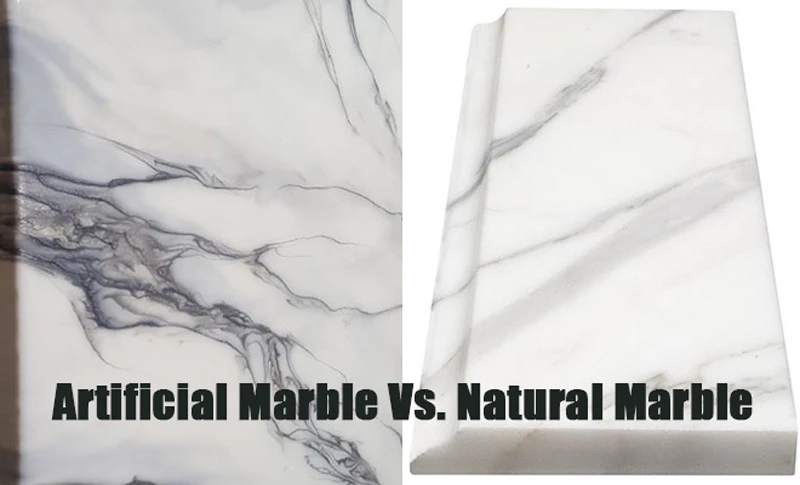
While artificial marble mimics the visual appeal of natural marble, their physical properties and long-term performance differ significantly:
| Property / Feature | Artificial Marble (Engineered) | Natural Marble (Calcite/Dolomite) |
|---|---|---|
| Primary Composition | Marble dust + Polyester/Epoxy Resin | 100% Earth-mined natural minerals |
| Pattern & Color | Highly uniform, customizable | One-of-a-kind natural veining |
| Porosity & Water Absorption | Very Low (< 0.05%) | Medium to High (Porous) |
| Scratch Resistance (Mohs) | 3 – 4 (Easier to scratch) | 3 – 5 (Slightly harder) |
| Heat Resistance | Low to Moderate (Prone to resin scorch) | High (Heat tolerant) |
| Stain Resistance | High surface stain resistance (via Gel Coat) | Low (Requires regular sealing) |
| Repairability | Moderate (Scratches hard to buff back) | High (Can be re-polished infinitely) |
| Average Initial Cost | Budget-Friendly | Premium / Luxury |
Pros and Cons of Artificial Marble
Advantages (Pros)
- Cost-Effective Solution: Significantly lower material and installation costs compared to rare quarry slabs.
- Seamless Color Uniformity: Ideal for large-scale commercial installations where batch-to-batch color matching is mandatory.
- Eco-Friendly Fabrication: Diverts quarry waste and marble dust from landfills by repurposing natural debris into functional surfaces.
- Integrated Moldability: Can be cast into seamless vanity tops, integral sinks, and shower basins without grout lines.
Disadvantages (Cons)
- Susceptible to Thermal Shock: Hot pans or boiling liquids can scorch or crack the resin binders.
- Sensitivity to Chemical Stains: Acidic household substances (citrus juices, harsh bathroom cleaners, or vinegar) can dull or etch the protective gel coating.
- UV & Fading Vulnerability: Exposure to direct sunlight causes resin yellowing and color fading over time; not recommended for outdoor use.
- Gel Coat Crazing: Over years of heavy use, microscopic hair-line fractures ("crazing") can appear in the top gel layer, allowing moisture buildup if neglected.
Best Applications for Artificial Marble
Due to its performance characteristics, artificial marble excels in specific environments:
- Ideal For: Bathroom vanity tops, integrated sink basins, shower wall panels, window sills, indoor wall cladding, and commercial hotel receptions.
- Not Recommended For: Kitchen countertops (due to high heat and knife scratches), outdoor patios (due to UV fading), or heavy industrial flooring.
How to Clean and Maintain Artificial Marble
To extend the lifespan and luster of artificial marble surfaces, follow these expert care recommendations:
- Daily Cleaning: Use a soft microfiber cloth with warm water and a pH-neutral cleaner or mild soap.
- Avoid Harsh Chemicals: Never use abrasive scouring pads, bleach, ammonia, or strongly acidic/alkaline chemical cleaners.
- Heat Protection: Always use trivets or heat pads under hot styling tools or hot cookware.
- Stain Prevention: Wipe up spills (especially coffee, wine, and toothpaste) immediately to prevent gel-coat dulling.
Final Verdict: Which Material Should You Choose?
- Choose Artificial Marble if: You are working within a strict project budget, desire uniform colors across large spaces, or need seamless integrated bathroom fixtures.
- Choose Natural Marble if: You want timeless elegance, unmatched organic veining, superior heat endurance, and a luxury surface that increases overall property value.
Looking for Premium Natural Marble Solutions?
If your project demands high durability, unique veining, and unmatched luxury finish, explore our exclusive collection of luxury natural marble slabs.
For technical consultation, custom stone sizing, or trade pricing,visit Marble Guide today to connect with our stone experts.